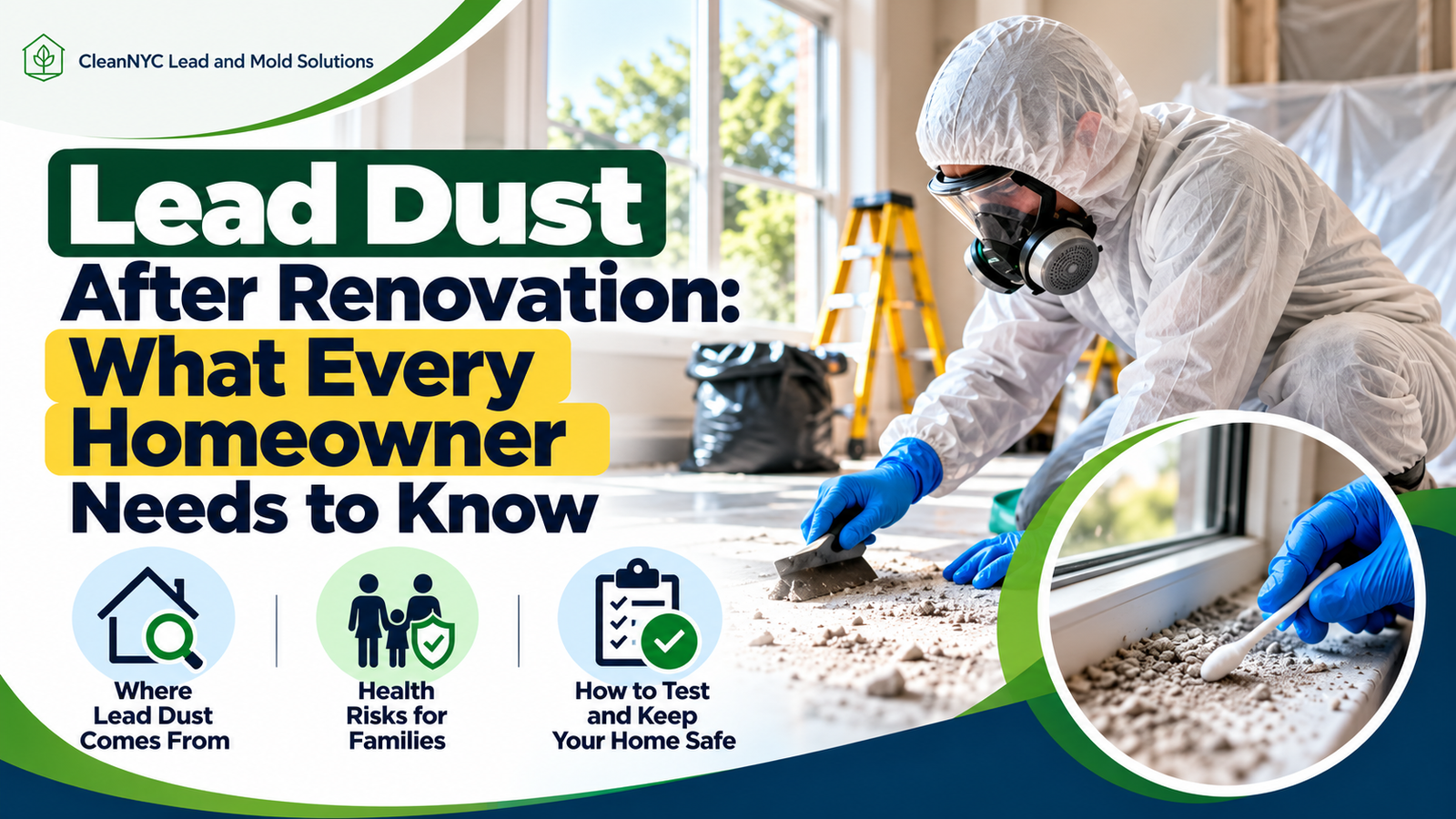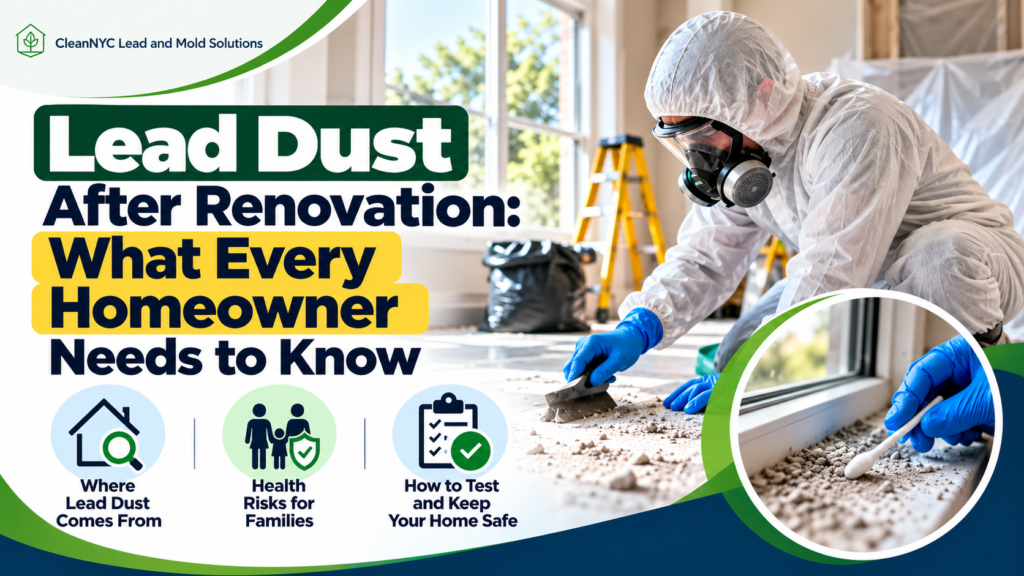
Lead dust after renovation can hide in a home that looks perfectly clean. The walls look fresh. The floors shine. Your contractor drives off with a wave. And somewhere in your home, a thin film of invisible dust may still be sitting on a windowsill.
Lead dust after renovation is one of the easiest risks to miss in an older home. Sanding, scraping, and demolition break old paint into particles you can’t see. Those particles settle on floors, sills, and toys, and young children pick them up on their hands.
This guide gives you the short answers first, then the details: where the dust comes from, what the EPA and New York City require, and how to confirm your home is actually clear.
Quick Answer: What Is Lead Dust After Renovation?
Lead dust after renovation is fine particulate created when work disturbs old paint that contains lead. It settles on surfaces, you can’t see it, and only a lab test can measure how much is left.
- Where it comes from: sanding, scraping, cutting, and demolition of painted surfaces
- Who’s at risk: mainly young children, per the CDC
- How to confirm it’s gone: a dust wipe test by a certified professional
Why Does Lead Dust Show Up After a Renovation?
Old paint isn’t dangerous while it sits intact. The trouble starts when someone cuts, sands, or scrapes it.
The U.S. Environmental Protection Agency (EPA) says about half of the homes built before 1978 have lead-based paint, and the odds rise with the age of the home, according to its Steps to Lead Safe Renovation, Repair and Painting guide. New York City banned lead paint in residential buildings in 1960, nearly two decades before the federal ban.
Windows and doors deserve special attention. They rub against their frames every day, so their paint wears down fastest, and replacing or adjusting them kicks that dust loose.
A Typical Scenario
Picture a kitchen remodel in a 1950s apartment. The crew pulls out cabinets, sands the walls, and replaces the window trim. The room looks clean by Friday. But the dust has already drifted into the hallway, settled behind the fridge, and landed on the windowsill where a toddler likes to play. Nobody did anything “wrong” in the usual sense. Nobody planned for the dust either.
How Dangerous Is Lead Dust?
The Centers for Disease Control and Prevention (CDC) states that no safe level of lead has been identified in children. Even low levels can reduce IQ, attention span, and academic achievement.
The CDC uses a blood lead reference value of 3.5 micrograms per deciliter. That number isn’t a safety line. It flags children who have more lead in their blood than most children their age.
Dust matters more than most owners realize. The New York City Health Department says dust from lead paint is the most commonly identified source of childhood lead poisoning. So the dust is often a bigger issue than the visible paint chips.
What Do the Rules Require?
The rules depend on where you live, how old the building is, and who does the work.
Federal: The EPA RRP Rule
The EPA’s Renovation, Repair and Painting (RRP) Rule covers paid work in homes and child-occupied facilities built before 1978. Contractors must:
- Hold EPA firm certification and use trained workers
- Give occupants the EPA’s Renovate Right pamphlet before work starts
- Contain the work area so dust and debris stay inside it
- Clean thoroughly, then complete a cleaning verification procedure
Minor repairs of 6 square feet or less per interior room are exempt. Anything larger needs lead-safe practices.
Federally assisted housing has an extra step. An EPA update notes that the U.S. Department of Housing and Urban Development (HUD) requires dust-lead testing after renovation in pre-1978 homes that receive federal assistance.
The EPA’s Updated Dust-Lead Levels
The EPA finalized stricter dust standards in 2024. After lead paint abatement, the dust-lead action levels are 5 micrograms per square foot on floors, 40 on window sills, and 100 on window troughs, per the agency’s final rule. The rule also defines a dust-lead hazard as any reportable level of lead on floors or interior window sills, as measured by an EPA-recognized lab. Compliance began January 12, 2026.
These numbers apply to abatement and risk assessment work. Ask your inspector which standard fits your project.
New York City: Local Law 1
New York City’s Local Law 1 of 2004 requires owners of buildings built before 1960 to presume the paint is lead-based. It also covers buildings from 1960 to 1978 when the owner knows lead paint is present.
The city’s housing agency bulletin says to use lead-safe work practices for repairs that disturb more than 2 square feet of paint in a single room. The Health Department also requires dust wipe clearance testing after work that disturbs more than 2 square feet of paint in a pre-1960 building where a child under six lives. If a sample fails, the area must be re-cleaned and tested again.
City guidance is blunt on one point: don’t dry scrape or dry sand lead paint. Numeric clearance limits in New York City have changed over time, so confirm the current Health Department standard before you test.
What Does a Lead-Safe Renovation Look Like?
A lead-safe job keeps lead dust after renovation under control from the first day to the last. Your contractor should:
- Seal off the work area so dust can’t travel to other rooms
- Use wet methods instead of dry sanding or scraping
- Protect floors and belongings with plastic sheeting
- Contain debris instead of letting it spread
- Clean with HEPA vacuums and damp wipes, not a regular broom or standard vacuum
- Verify the cleaning before anyone moves back in
Ask to see the firm’s EPA certification before work begins. A good contractor hands it over without fuss.
Cleaning Verification vs. Dust Wipe Test: What’s the Difference?
Cleaning verification is a visual check. A dust wipe test is a lab test. They answer different questions.
| Feature | Cleaning Verification | Dust Wipe Test |
|---|---|---|
| What it is | Wiping surfaces with a damp cloth and comparing it to an EPA card | Collecting dust samples and sending them to a lab |
| Who does it | Certified renovator | EPA-certified inspector or risk assessor |
| Lab analysis | No | Yes |
| Result | Pass or fail by appearance | Lead measured in micrograms per square foot |
The RRP rule requires cleaning verification, but not lab testing, for most homes. As one housing compliance resource explains, cleaning verification means wiping horizontal surfaces with a disposable moist cloth and comparing it to the EPA card.
Here’s the catch: you can’t see lead dust. A surface can pass a visual check and still carry measurable lead. A lab result is the stronger proof.
How Do You Know Lead Dust Is Gone?
- Let the cleanup finish. Testing early gives misleading results.
- Hire an independent inspector. In New York City, the Health Department’s sampling affidavit says the inspector must have no relationship with the owner or the contractor who did the work.
- Collect wipe samples from floors, window sills, and window troughs.
- Compare lab results against the standard that applies to your project.
- Re-clean and retest if any sample fails.
- Keep the paperwork. Lab reports and certificates protect you later.
Should You Test? A Decision Guide for Owners
Consider testing if any of these apply:
- The home or building was built before 1978
- The work involved sanding, demolition, or window and door replacement
- A child under six lives in or visits the home
- You own rental property and you’re turning over a unit
- You’re in a pre-1960 New York City building where clearance testing may be required
- Your contractor can’t show lead-safe certification
Treat testing as risk management. A failed inspection, a tenant complaint, or a child’s elevated blood lead level costs far more than a few wipe samples. Firms such as CleanNYC Lead and Mold Solutions provide this kind of lead testing for New York City properties.
Can You Clean Up Lead Dust Yourself?
It depends on who’s doing the work and where. The EPA RRP rule covers paid work, though the agency encourages homeowners to follow lead-safe practices on their own projects too. In New York City, the housing agency says owners can do lead-safe work themselves only if they are properly certified.
For anything beyond a minor repair, hire a certified firm. Then have an independent inspector test afterward, so the person who did the cleaning isn’t the one grading it.
Common Mistakes That Spread Lead Dust
- Dry sanding or dry scraping. City guidance says not to do it.
- Skipping containment. Dust travels farther than most people expect.
- Using a standard vacuum or a broom. Lead-safe cleaning relies on HEPA equipment and damp wipes.
- Trusting your eyes. A spotless room can still hold lead dust.
- Letting kids back in too soon. Wait for confirmation, not a hunch.
- Hiring uncertified help. Paid work in pre-1978 homes requires an EPA-certified firm.
Frequently Asked Questions About Lead Dust After Renovation
The Bottom Line
Lead dust after renovation is invisible, preventable, and easy to overlook. Know your building’s age, hire certified contractors, insist on containment and wet methods, and confirm the cleanup with a lab test instead of a quick look.
Finished a renovation in a pre-1978 home, or planning one in New York City? Contact a qualified lead inspection professional for dust wipe testing before anyone moves back in.