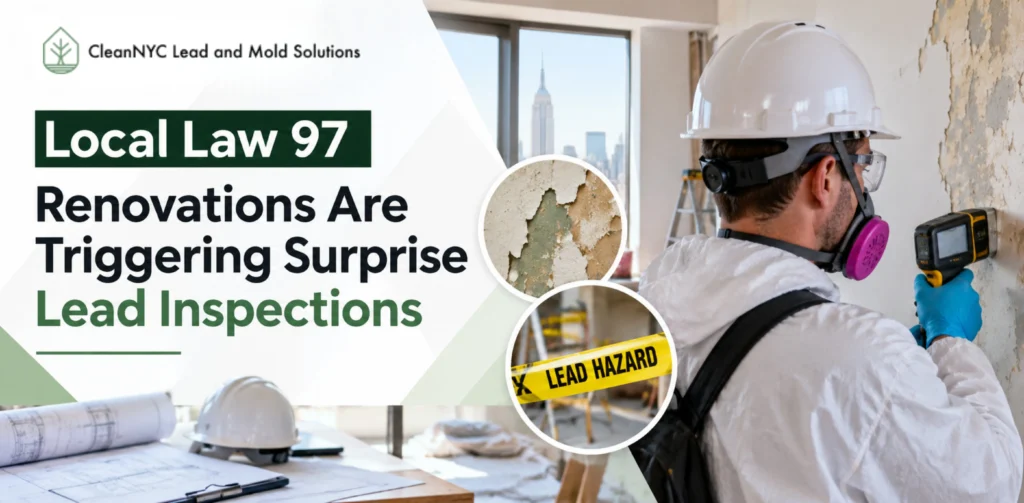
Local Law 97 Renovations Are Triggering Surprise Lead Inspections
Picture this. You hired a contractor to cut your building’s carbon output under Local Law 97. Two weeks in, the crew opens a window frame and asks a question nobody budgeted for: “Has anyone tested this paint for lead?”
Here’s the twist. No inspector shows up because you filed an emissions report. The surprise comes from the work itself. Retrofits disturb old paint, and disturbed paint pulls lead rules into your project fast.
This guide explains how Local Law 97 renovations collide with lead regulations, what NYC and the EPA require, and how to plan so one compliance project doesn’t create a second problem.
What Is Local Law 97, and Why Are Owners Renovating Now?
Local Law 97 is New York City’s building emissions law. It caps annual carbon emissions for most buildings over 25,000 gross square feet and backs those caps with significant fines.
Owners searching “NYC Local Law 97” usually want three answers: does it cover my building, what does it cost, and when do I act? Here is the short version:
- Filing: Reports covering 2025 emissions were due May 1, 2026, with a grace period through June 30, 2026.
- Penalty: The city began issuing penalty notices on May 1, 2026, at $268 per metric ton of CO₂ over the limit.
- Coverage: The Department of Buildings says the law reaches roughly 50,000 buildings above 25,000 square feet.
Local Law 97 News: What the September 2026 Numbers Show
The freshest data landed this month. The Department of Buildings told the City Council that about 95% of covered market-rate buildings have met their limits or taken steps to do so, and 16 properties over their limits are paying roughly $270,150 in penalties.
That sounds calm. It isn’t. Fewer than 10% of properties exceeded their cap for the 2024–2029 period, but about 57% are projected to exceed the limits for 2030–2034.
That gap explains why Local Law 97 compliance work is heading for your windows, walls, and mechanical rooms. One industry analysis also warns that waiting until 2028 or 2029 means competing with thousands of other buildings for contractors, equipment, and utility connections. Early projects get better pricing. They also get lead surprises earlier, when you still have time to fix them.
Why Local Law 97 Compliance Work Touches Lead Paint
Energy upgrades sound clean. The work isn’t. Replacing windows, sealing envelopes, and swapping systems means cutting, scraping, and opening painted surfaces. Boilers get the headlines, but window frames get the paperwork.
Three authorities point the same direction:
- The EPA says any activity that disturbs paint in pre-1978 housing is covered by its lead rule, and window replacement is on the list.
- The Building America Solution Center advises that retrofit workers should assume paint in pre-1978 homes is lead based.
- In New York, HPD presumes that all paint in a pre-1960 multiple dwelling unit where a child under 6 lives, and in its common areas, is lead paint.
If your building is older, you sit in the overlap zone. Lead paint doesn’t care about your carbon cap.
Which Lead Rules Apply When Retrofit Work Starts?
Three layers apply. Each has different triggers, so read all three.
The EPA’s Renovation, Repair and Painting (RRP) Rule
Anyone paid to disturb paint in homes, child care facilities, and preschools built before 1978 must be EPA-certified, and their workers must be trained in lead-safe practices. The rule generally exempts homeowners working on their own homes, but it does apply if you rent all or part of the property.
Small jobs get a pass. Minor work that disturbs six square feet or less of paint per room inside, or 20 square feet or less outside, is exempt. A window replacement is not a minor job.
NYC Local Law 1 Work Practices
HPD’s guide sets tougher triggers for pre-1960 multiple dwellings, and for 1960–1978 buildings where the owner knows lead paint exists. They apply when work happens in a unit where a child under six lives, or in common areas. HPD counts a child as living there if they routinely spend 10 or more hours per week in the unit.
Once work crosses the line, disturbing more than 100 square feet of paint per room, or removing two or more windows, requires an EPA-certified abatement firm. The same guide adds these requirements:
- A notice of commencement filed with the Department of Health at least ten days before work starts.
- Clearance dust testing by an independent third party after the work.
- Records kept for ten years.
- No open-flame burning, no dry sanding, and no dry scraping.
Notice that common areas count. Lobby, hallway, and stairwell window work can trigger these rules even when no child lives in the building.
Local Law 31 XRF Testing
Owners of pre-1960 rental housing, and of 1960–1978 housing with known lead paint, had to complete XRF testing in all units by August 2025. Testing now uses an action level of 0.5 mg/cm².
If you have those reports, you know where lead sits before you sign a retrofit contract. If you don’t, a construction schedule is a poor time to find out.
Where the Surprise Inspections Come From
Most “surprises” trace back to four spots. Owners often don’t see them coming.
Your contractor’s pre-work check. A certified renovator can test components with an EPA-recognized kit or send paint chips to a lab to declare them lead-free. A positive result stops the schedule until you have a plan.
Clearance testing. After covered work, a third party collects three wipe samples per room, from the window well, the sill, and the floor, plus floor samples from adjacent areas. The limits are 5 micrograms of lead per square foot on floors, 40 on sills, and 100 in window wells. A failed sample means repeating the cleanup and retesting. That’s an inspection you schedule, but it often surprises the budget.
HPD audits. Local Law 127 lets HPD select buildings for audit using data on elevated blood lead levels in certain areas identified by the Department of Health. You don’t control where those areas are.
Common-area violations. Peeling lead paint in a common area of a multiple dwelling where an applicable child lives is a Class C violation. Retrofit dust and disturbed coatings can create exactly that condition.
How to Plan Local Law 97 Renovations Without Lead Surprises
Think of this as a prenup for your retrofit. It costs little now and saves a lot later.
- Confirm your building’s age and layout. Year built and unit mix tell you which rules apply.
- Pull existing XRF reports. Local Law 31 results show where lead paint is and isn’t.
- Map your scope against the triggers. Count windows, estimate painted square footage per room, and flag common areas.
- Test before you bid. Have an EPA-certified inspector XRF the surfaces your retrofit will touch. CleanNYC Lead and Mold Solutions offers XRF lead testing and dust wipe clearance testing across the five boroughs, so one team can cover both ends of the job.
- Hire the right certification. Ask every contractor for their EPA firm certification in writing.
- File on time. If you cross the 100-square-foot or two-window triggers, file the Department of Health notice at least ten days ahead.
- Book independent clearance testing. Owners must give the dust clearance results to the occupants.
- Keep the file for ten years. Reports, notices, contracts, and clearance results all belong in it.
For background on who needs testing, see our guide to lead paint testing in NYC.
Which Path Fits Your Building?
- Built before 1960 (multiple dwelling): Assume lead until XRF results say otherwise. HPD’s presumption covers common areas and units with young children.
- Built 1960–1978: The EPA’s RRP rule covers paid renovation work. Local Law 1 applies when you know lead paint is present.
- Built 1978 or later: RRP generally doesn’t reach you. Still check for asbestos, which can hide in vermiculite insulation, pipe and duct insulation, and old plaster.
Local Law 97 Lead Renovation FAQs
Does Local Law 97 require a lead inspection?
No. Local Law 97 sets carbon limits and reporting rules. Lead requirements come from the EPA and NYC agencies, and they depend on your building’s age and the paint your work disturbs.
Do I need lead testing before replacing windows in an older NYC building?
Often, yes. The EPA’s rule covers paid window replacement in pre-1978 housing. Under HPD’s rules, removing two or more windows in a pre-1960 multiple dwelling triggers an EPA-certified abatement firm and a health department notice when a child under six lives there or the windows sit in common areas.
What does lead clearance testing involve?
An independent professional collects three wipe samples per work area, from the window well, sill, and floor, plus adjacent floors. A lab then compares results against HPD’s limits. Failed samples mean re-cleaning and retesting.
How long should I keep lead records?
HPD requires owners to keep records of lead-related work for ten years, and to make them available on request.
Can my general contractor handle lead-safe work?
Only with the right certification. The EPA requires firms paid to disturb paint in pre-1978 housing to be certified, with trained workers on site.
What is the Local Law 97 penalty?
Buildings over their limit face $268 per metric ton of CO₂ above the cap. Late or missing reports carry separate penalties.
The Bottom Line on Local Law 97 Compliance and Lead
Local Law 97 NYC owners face a clear deadline curve: easy now, harder in 2030. The retrofits that get you there will open old walls and windows. Plan for lead testing before renovation in NYC buildings, and the surprise disappears. Skip it, and a carbon project becomes a health-and-safety project overnight.
Start with the facts. Test first, hire certified crews, and document everything. If you want a team that can run XRF testing before the work and clearance testing after it, contact CleanNYC Lead and Mold Solutions at 212-381-6001 or visit cleannyclmd.com to book an inspection.
This article is general information, not legal advice. Confirm your obligations with HPD, the Department of Buildings, or qualified counsel.
Sources
- Bueno Analytics — 2026 Building Emissions Compliance Guide
- Urban Green Council — NYC Building Emissions Law Overview
- The City Reporter — Compliance High on NYC Emission Rules So Far, With Much Tougher Goals to Come